Natural gas-fired combined-cycle plants made up roughly 293.7 GW of net summer capacity as of December 2025, according to EIA's generator data. That's a massive slice of the US generating fleet, built one power block at a time.
The basic concept is simple enough. But the way the gas turbine, HRSG, steam turbine, condenser, and controls actually interact trips up a lot of people. This guide walks through the full sequence, start to finish.
Key Takeaways
- A gas turbine generates power first, then its hot exhaust produces steam for a second turbine via the HRSG
- The gas turbine runs on the Brayton cycle; the steam turbine runs on the Rankine cycle
- Five subsystems (HRSG, steam-water circuit, condenser, feedwater system, and controls) tie both cycles together
- Output and efficiency shift with ambient conditions, load, fuel, cooling method, and maintenance quality
What Is a Combined-Cycle Power Plant?
A combined-cycle power plant converts fuel into electricity using two thermodynamic cycles stacked in sequence: a gas-turbine Brayton cycle followed by a steam-turbine Rankine cycle. The EIA defines combined cycle simply as generation technology that uses gas-turbine exhaust heat to run a steam cycle.
Here's the problem it solves. A gas turbine's exhaust leaves the turbine section still carrying substantial thermal energy, often several hundred degrees Fahrenheit. A simple-cycle gas turbine plant just vents that heat out the stack. Combined-cycle design captures it instead.

The energy path runs like this:
- Fuel and compressed air combust, releasing energy
- The gas turbine converts part of that energy into shaft power and electricity
- Hot exhaust transfers remaining heat into steam
- The steam turbine converts that recovered heat into more electricity
Combined-Cycle vs. Simple-Cycle and CHP
Three terms get mixed up often, so here's the distinction:
- Simple-cycle gas turbine plants burn fuel, spin one generator, and vent exhaust heat unused. They start faster and cost less to build, but run less fuel-efficient over sustained operation
- Combined heat and power (CHP) plants are built from the ground up to deliver both electricity and usable heat for a process or district system
- Combined-cycle plants are built primarily to maximize electricity output, though some are configured to also supply process or district heat
Common Plant Configurations
Most US combined-cycle installations use a 2x1 configuration: two combustion turbines feeding one steam turbine through two HRSGs. EIA noted this is the predominant arrangement. Single-turbine (1x1) and larger multi-shaft arrangements also exist, depending on site needs and turbine size.
A few design variations worth knowing:
- Multi-pressure HRSGs (single, double, or triple pressure) extract more heat from exhaust gas than single-pressure designs
- Supplementary firing adds extra fuel combustion in the HRSG duct to boost steam output when demand spikes
- Air-cooled condensers reduce water use but can cost some output in hot weather, versus water-cooled systems
- Combined heat-and-power variants divert some steam to process use instead of the turbine
Why the Technology Still Matters
Combined-cycle plants remain central to the US grid because they combine strong fuel efficiency with dispatchability. The EIA's 2024 data shows plants of this type average a tested heat rate of 7,548 Btu/kWh at full load, meaning they need less fuel per unit of electricity than many older thermal plants.
They also ramp faster than steam-only plants, which matters as wind and solar generation grows. That said, efficiency and emissions outcomes aren't fixed numbers. They shift with:
- Plant design and turbine class
- Operating load and ambient temperature
- Fuel quality
- Cooling system type
- Maintenance condition
No single efficiency figure applies to every plant. Treat any number you see as a specific operating basis, not a universal constant.
How Does a Combined-Cycle Power Plant Work?
Think of the whole plant as one continuous loop. Air and fuel enter the gas turbine. Exhaust heat flows into the HRSG. Steam drives the steam turbine. Condensed water returns to the HRSG to start the steam side over again.
Initiation: Air Compression and Combustion
Filtered ambient air enters the gas turbine's compressor section first. Rotating compressor stages squeeze that air to high pressure before it reaches the combustor.
Inside the combustor, fuel—usually natural gas, though some turbines support liquid fuels or blends—mixes with the compressed air and ignites. This creates a continuous stream of high-temperature, high-pressure combustion gas.
During normal operation, combustion runs continuously. Startup, shutdown, ignition sequencing, fuel admission, purge cycles, and grid synchronization are all handled by automated control systems rather than manual operator intervention.
What can go wrong at this stage:
- Poor fuel quality or unstable pressure disrupts combustion stability
- Compressor fouling from dirty inlet air reduces efficiency
- Hot or humid inlet air lowers air density and output
- Combustion control errors risk exceeding emissions limits
- Improper startup sequencing can trip protective systems
Core Operation: Gas Turbine Generation
Expanding combustion gases rush through multiple turbine stages, forcing the turbine shaft to rotate at high speed. That single rotating shaft does double duty: part of its mechanical output drives the compressor (to keep compressing incoming air), and the rest turns an electrical generator.
Several variables determine how much power comes out:
- Compressor inlet temperature (cooler air generally means more output)
- Pressure ratio across the compressor
- Turbine firing temperature
- Airflow rate and fuel composition
- Overall turbine mechanical condition
This stage produces the plant's first block of electricity. Critically, the exhaust leaving the turbine is still hot enough to drive a second generation cycle—that's the entire premise of combined-cycle design.
Heat Recovery: HRSG Steam Production
Instead of going straight to the stack, gas turbine exhaust flows through the heat recovery steam generator (HRSG). Inside, that heat transfers into feedwater across three zones: economizer, evaporator, and superheater sections, arranged in sequence.
Feedwater heats up, turns to saturated steam, then becomes superheated steam. The exact path depends on whether the HRSG uses single-, double-, or triple-pressure circuits—a design detail covered in GE's technical reference on combined-cycle configurations.
Key components controlling this process:
- The steam drum manages circulation and separates steam from water
- Ducting and dampers direct exhaust flow
- Supplementary firing (where installed) adds heat on demand
- The stack releases cooled exhaust gas after heat recovery
Practical limits matter here too. Fouling on heat-transfer surfaces reduces efficiency over time. Thermal stress and corrosion are ongoing maintenance concerns. Engineers also have to balance how much heat they recover against acceptable pressure drop across the HRSG—recover too aggressively and you choke exhaust flow.
Steam Turbine Generation and Condensation
High-pressure steam from the HRSG expands through the steam turbine, spinning turbine stages connected to a second generator shaft. This produces additional electricity—purely from heat that would otherwise have been wasted.
After expansion, steam enters the condenser, where it turns back into water. Running the condenser under vacuum improves how fully the steam expands in the turbine, but that vacuum depends on reliable cooling and air-removal equipment working continuously.
Condensate and feedwater pumps then push that water back through the feedwater system and HRSG, closing the loop. Water gets reused rather than discarded.
Condenser cooling method affects plant performance noticeably:
- Cooling towers recirculate water with some evaporation loss
- Once-through systems withdraw and return water, generally from a large nearby source
- Air-cooled condensers cut water use substantially but can raise back pressure and reduce output during hot weather
EPRI's cooling comparison found dry cooling saved an estimated 2,800 acre-feet of water annually at one studied plant, at a cost of roughly 2% lower annual output on average—with a bigger penalty during the hottest hour. These numbers are plant- and site-specific, not a universal rule.

Regulation, Control, and Steam Conditioning
A distributed control system (DCS) coordinates nearly everything: fuel flow, compressor and turbine operation, HRSG pressure and temperature, steam admission to the turbine, generator synchronization, condenser conditions, emissions controls, and protective trips.
When grid demand shifts, the plant responds through load-following gas turbine control, steam bypass valves, duct firing (if equipped), and coordinated startup or shutdown sequences.
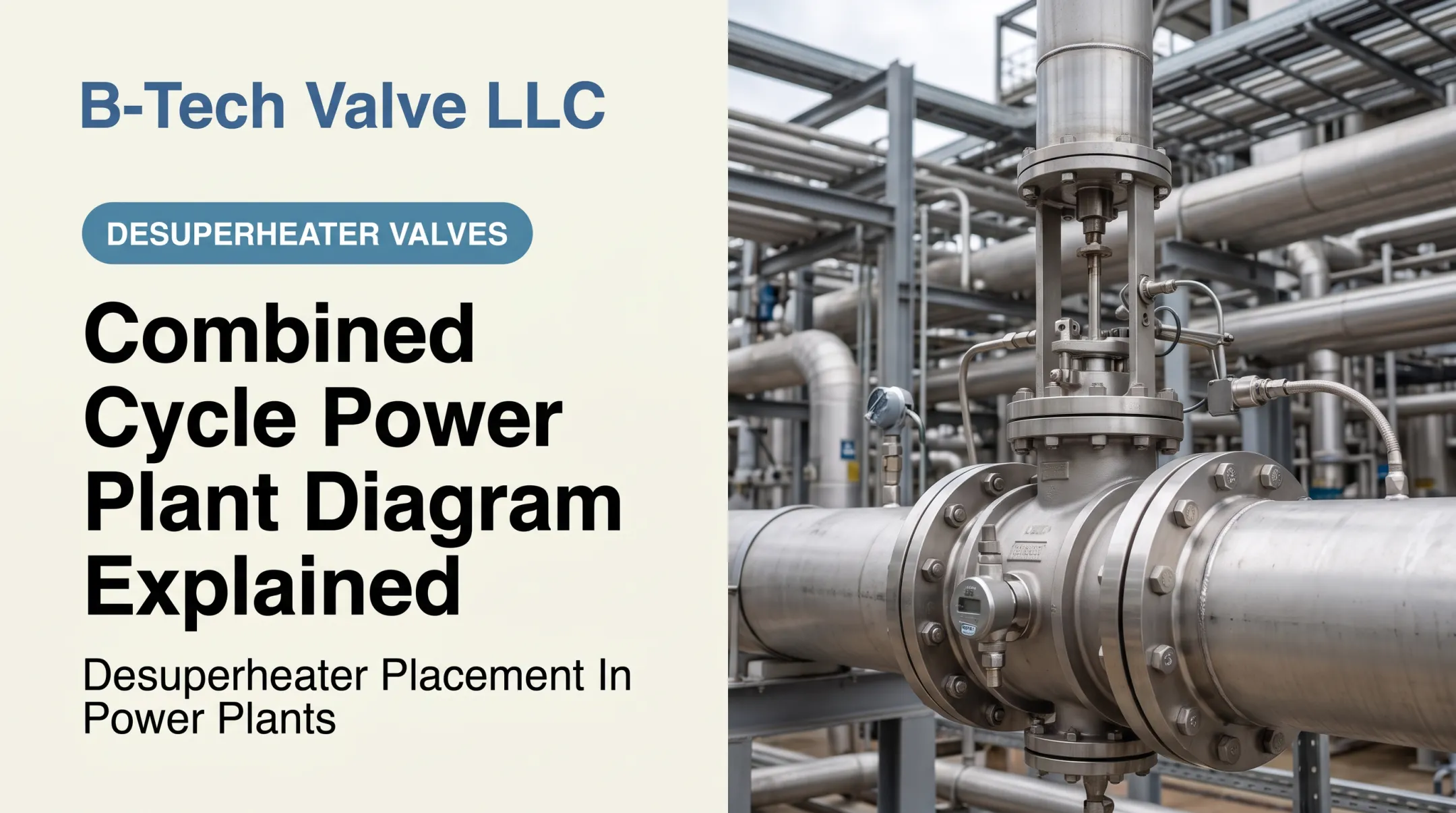
Steam temperature control deserves special attention. Superheated steam that runs too hot can damage HRSG outlet piping, steam turbine blading, seals, and downstream valves. That's where desuperheaters and attemperators come in—devices that inject a precisely controlled amount of water into the steam flow to bring temperature down to a safe setpoint.
This is a narrow but critical piece of the control puzzle. B-Tech Valve, for instance, builds American-made desuperheater and attemperator valves specifically for this job—its LPD line handles large steam pipes (6 inches and up) with a combined variable-nozzle control valve and desuperheater in one assembly, while its SPAD line serves smaller pipes (4 inches and under) using a spray-ring design paired with a separate temperature-control valve. Components like these are one piece of steam conditioning, not a stand-in for the whole plant's control system.
Output: Electricity, Heat Rate, and Operational Results
Total plant output combines electricity from the gas turbine generator plus additional electricity from the steam turbine generator. The exact split varies by configuration—typically the gas turbine contributes roughly two-thirds of output, with the steam turbine contributing the rest, though this isn't fixed across every plant.
Heat rate measures fuel energy consumed per unit of electricity produced. Lower heat rate generally means better fuel-use performance—less fuel burned for the same output.
Two data points illustrate this, on different bases:
| Source | Metric | Value |
|---|---|---|
| EIA (2024 tested average) | Heat rate | 7,548 Btu/kWh |
| NETL (2023 modeled F-class design) | Net efficiency | 52.9%–53.6% HHV |
Don't treat these as directly comparable—one is a fleet-wide tested average, the other is a modeled design case for specific turbine classes. Real-world output quality ultimately shows up downstream in ramp rate, availability, emissions intensity, water consumption, startup time, and maintenance demand.
Where Are Combined-Cycle Power Plants Used?
Combined-cycle plants serve several roles across the US electricity system: utility-scale baseload and intermediate generation, independent power production, and grid support for regions needing reliable large-scale output.
Industrial and captive-power applications are common too:
- Refineries conditioning steam for process heat
- Chemical plants needing both power and steam
- Pulp and paper facilities with continuous steam demand
- Manufacturing sites and cogeneration facilities
- Campuses running district heating alongside power generation
The Department of Energy notes that more than 75% of US gas-turbine CHP capacity runs in large combined-cycle systems, a sign of how often these plants double up on heat and power duty.
Where Combined-Cycle Plants Perform Best
These plants fit well where several conditions line up:
- Continuous or load-following service is needed
- Reliable fuel supply and transmission access exist
- A suitable cooling arrangement (water or air) is feasible
- Emissions permitting requirements can be met
- Maintenance staff and spare-parts access are available
Those same conditions shape how combined-cycle plants stack up against other options. They generally offer better fuel efficiency than simple-cycle turbines or coal plants, though simple-cycle units start faster and cost less upfront.
Renewables paired with storage avoid fuel costs entirely but can't always match dispatchable, on-demand output. Each option trades off differently on capital cost, flexibility, and emissions. There's no single best answer across every site.
One example for scale: the CPV Towantic Energy Center in Oxford, Connecticut, runs an 805 MW, 2x1 configuration using GE 7HA.01 turbines. It illustrates one set of design choices, not a template every plant follows. Sizing and configuration stay application-specific.
Conclusion
The logic holds together simply once you follow the sequence: the gas turbine generates electricity from combustion, the HRSG captures its exhaust heat, and the steam turbine squeezes out additional electricity before condensing and recycling that water.
Understanding this chain helps with real operational decisions:
- Evaluating heat rate
- Choosing a cooling approach
- Tuning controls
- Managing steam temperature
- Specifying components rated for your plant's actual pressure, temperature, and flow conditions
That last piece, steam-temperature management, is where attemperation equipment earns its keep protecting the rest of the system downstream.
Frequently Asked Questions
How much does a combined-cycle power plant cost?
Cost varies by capacity, turbine and HRSG configuration, cooling system, emissions controls, and site conditions. EIA and Sargent & Lundy estimate overnight costs around $870–$920 per kW net for recent H-class designs.
What is a combined-cycle power plant?
It's a power plant that combines a gas-turbine cycle with a steam-turbine cycle, using gas-turbine exhaust heat to generate additional electricity. This two-stage approach extracts more usable energy from the same fuel than a gas turbine running alone.
How efficient is a combined-cycle power plant?
Efficiency depends on plant design, load, ambient temperature, fuel, and cooling method. EIA reports a 2024 tested average heat rate of 7,548 Btu/kWh, while NETL's modeled F-class designs show net efficiencies around 53-59% depending on measurement basis.
Which cycle is used in a gas power plant?
A simple gas-turbine power plant runs on the Brayton cycle alone. A combined-cycle plant adds a Rankine steam cycle on top, recovering exhaust heat that would otherwise be wasted to generate more electricity.
What are gas turbine power plants?
These plants burn fuel to create expanding hot gases that spin a turbine connected to a generator. Simple-cycle plants stop there; combined-cycle plants add a steam cycle to capture leftover exhaust heat.
Can we use natural gas for power generation?
Yes, natural gas is widely used in both simple-cycle gas turbines and combined-cycle plants across the US. Site-specific fuel supply, emissions controls, and permitting still need assessment before development.