A control valve is the hardware that keeps a process variable locked near its target by continuously adjusting a flow passage. This article covers what a control valve actually is, how the control loop operates, the major valve types you'll encounter on a plant floor, the factors that drive proper selection, and how control valves function specifically in steam systems.
Key Takeaways
- Control valves regulate a process variable by changing the size of an internal flow passage
- Full assemblies typically include the valve body and trim, an actuator, and often a positioner
- Modulating valves adjust flow continuously, while on/off valves simply start or stop it
- Correct selection hinges on fluid properties, operating conditions, required control behavior, and safety requirements
What Is a Control Valve?
A control valve is the final control element in an automated process loop. It receives a signal from a controller and adjusts fluid flow in response, closing the gap between what's actually happening in the pipe and what the process demands.
The IEC 60534-1:2023 standard establishes this terminology for industrial process control valves, giving engineers a shared vocabulary across manufacturers and applications.
Process Variables a Control Valve Regulates
Control valves aren't limited to one job. Depending on where they sit in a system, they manage:
| Variable | Industrial Example |
|---|---|
| Flow | Cascade control adjusts steam valve output to match shifting process flow in a heat-exchanger duty |
| Pressure | A backpressure loop holds inlet steam pressure at setpoint, with the valve responding as pressure falls |
| Temperature | A heat-transfer loop pairs a temperature transmitter with a control valve to hold process temperature steady |
| Level | A level transmitter and control valve work together to continuously remove condensate from a heat-transfer process |
These examples come straight from DOE's steam brief on industrial process-control schemes, and they illustrate a core point: the same valve concept applies whether you're managing gas, liquid, or steam.
How a Control Valve Creates Change
Internally, the valve regulates flow by changing the effective opening between a plug, ball, disc, or nozzle and its seat. Move that internal element, and you change the restriction. Change the restriction, and you change the flow.
"Control valve" describes a function, not a single body design. Globe, ball, butterfly, and plug valves can all perform control duty when properly actuated and sized for the application.
Control Valves vs. Isolation Valves vs. Check Valves
It's easy to lump all valves together, but the distinctions matter:
- Control valves continuously adjust position in response to a command signal
- Isolation valves exist primarily to shut flow off completely, not to throttle it
- Check valves allow flow in one direction only and prevent backflow automatically, with no external signal involved
How Does a Control Valve Work?
A control valve doesn't act alone. It's one piece of a feedback loop designed to keep a process steady despite constant disturbances.
The Feedback Loop
- A sensor measures the process variable, such as temperature or flow rate
- A controller compares that measurement against the setpoint
- A command signal travels to the actuator, telling it how far to move
- The actuator repositions the valve's closure element
- The sensor measures again, closing the loop

Actuators: Converting Energy into Motion
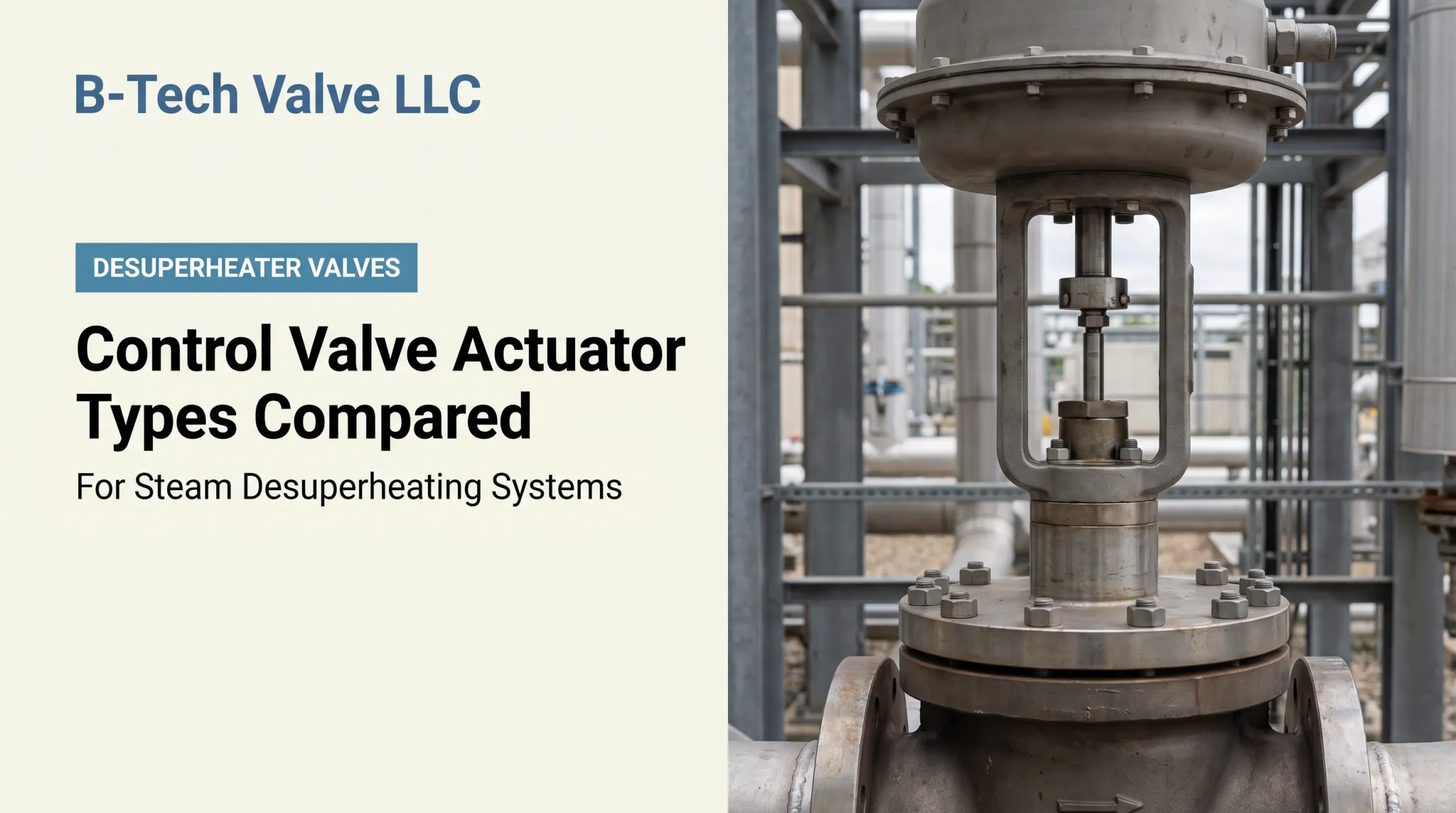
The actuator takes pneumatic, electric, or hydraulic energy and turns it into linear or rotary movement. Spring-and-diaphragm pneumatic actuators are common for general throttling, while pneumatic piston designs deliver higher thrust where the application demands it.
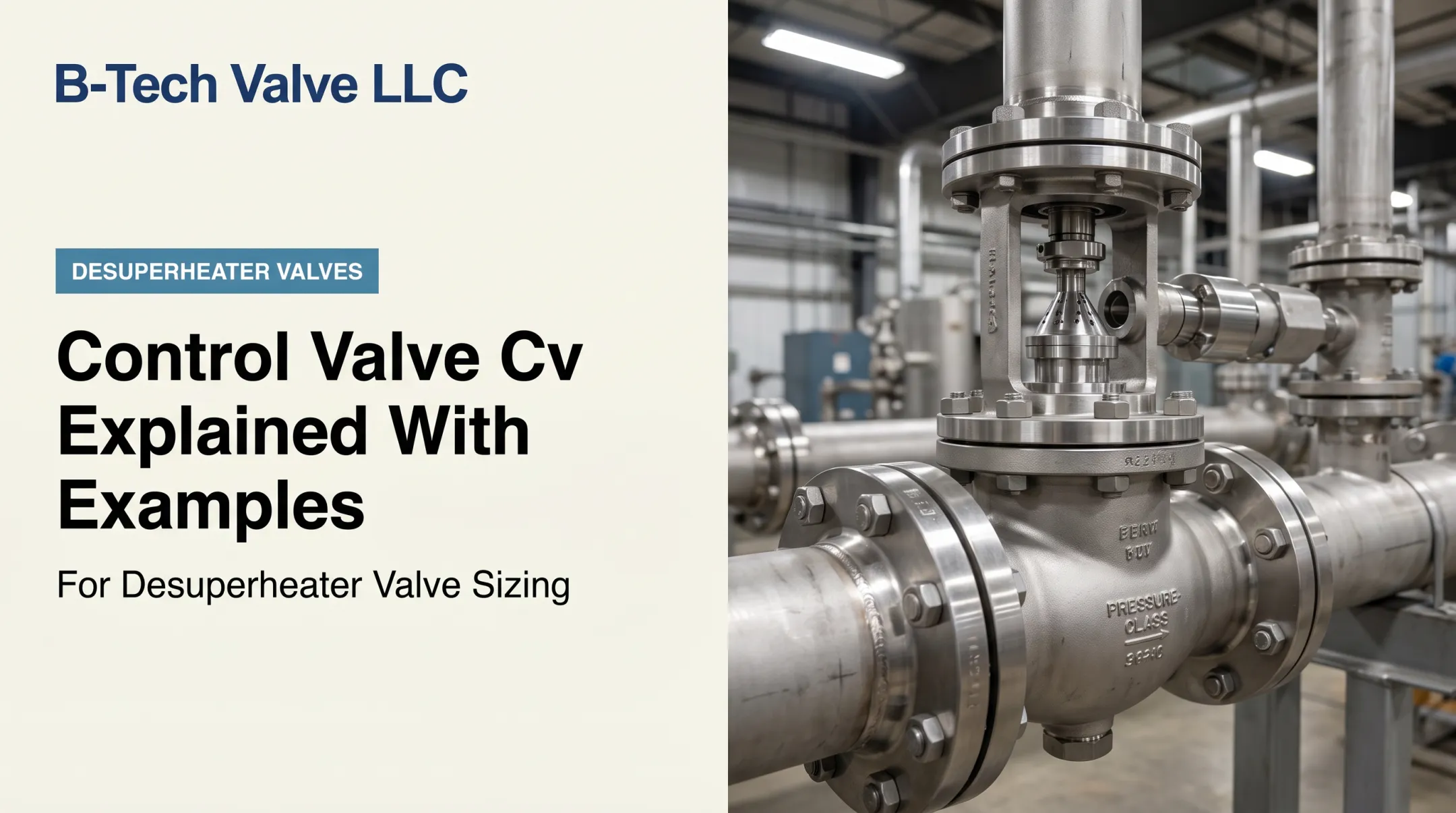
Here's a concrete example from B-Tech Valve's product line: the LPD Large Pipe Desuperheater is a probe-type, variable-nozzle control valve built for steam pipes 6 inches and larger. It uses a 3-inch flanged insertion to inject cooling water directly into superheated steam, with the actuator adjusting nozzle position to control exactly how much water enters the steam path.
The Role of the Trim
The trim is what actually changes the flow passage. In a cooling-water example like the LPD, the trim's nozzle geometry determines how finely the valve can meter water injection across a range of steam flow conditions. Get the trim design wrong, and you get poor control resolution even with a perfectly functioning actuator.
Positioners: Correcting for Real-World Friction
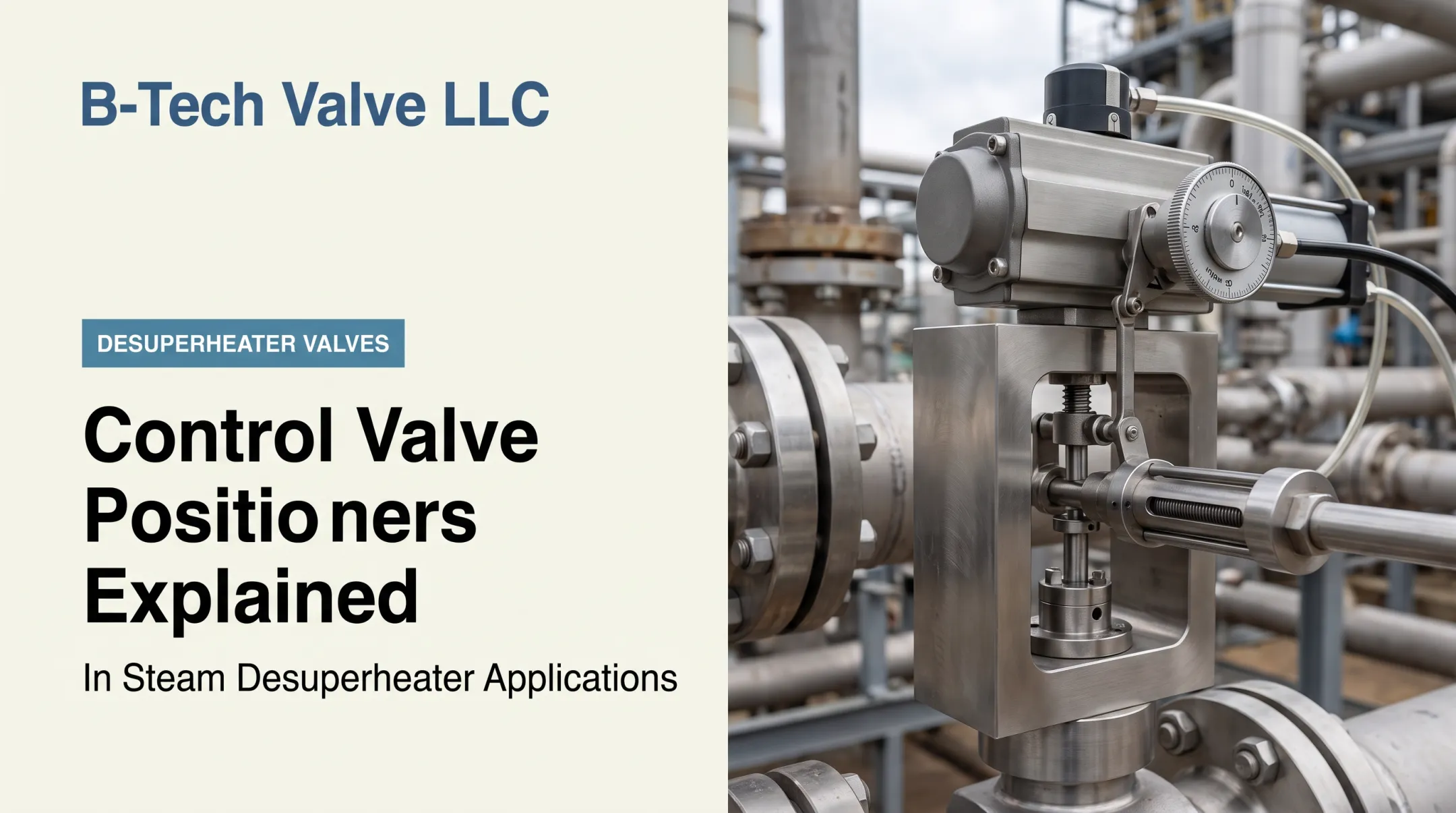
A positioner compares the requested valve position against the actual position and corrects any mismatch. This matters because friction, changing differential pressure, and other forces can cause a valve to drift from where the controller told it to go. Positioners are typically used wherever precise throttling is required.
Failure Behavior Isn't Optional
Every control valve needs a defined failure action:
- Fail-closed: the valve shuts on loss of actuating energy
- Fail-open: the valve opens on loss of actuating energy
- Fail-in-place: a solenoid arrangement traps actuator air to hold the last position
The right choice depends entirely on the process hazard and equipment protection requirements at that specific point in the system. There's no universal answer here, and treating it like a default setting is a mistake.
What Are the Main Types of Control Valves?
Control valves fall into two functional categories.
Modulating control valves operate at intermediate positions, continuously adjusting flow, pressure, temperature, or level as conditions change.
On/off valves move only between fully open and fully closed. They handle isolation, sequencing, filling, draining, or emergency shutdown. Throttling an on/off valve partway can damage designs not built for that duty.
Common Body Styles
| Body Style | Best Suited For |
|---|---|
| Globe | Precise throttling and demanding control duties; generally offers a wider control range |
| Ball / segmented-ball | Rotary operation with good rangeability; segmented-ball designs handle viscous, erosive, or slurry-laden fluids well |
| Plug | Eccentric rotary motion reduces friction and wear; suited to throttling or on/off service in erosive or coking conditions |
| Butterfly | Compact, higher-capacity layouts; narrower control range, often better for fixed-load duties |
| Needle / specialized | Fine adjustment for lower-flow, high-precision applications when supported by the process design |
Actuators Are Chosen Separately from Body Style
Don't confuse body style with actuator type. Select pneumatic, electric, or hydraulic actuators based on:
- Available air or electrical utilities
- Required response speed
- Force needed to overcome process pressure
- Hazardous-area classification
- Required failure behavior
If you need specific control-range numbers, signal standards, or leakage classes for a given design, verify those figures against the applicable ISA or IEC standard rather than relying on general industry assumptions.
Choosing a Control Valve for an Industrial System
Selection starts with data, not a catalog page.
Process Data You Need First
Before specifying anything, gather:
- Fluid or steam composition
- Normal and maximum flow rates
- Inlet and outlet pressure, plus pressure differential
- Operating and design temperature
- Pipe size and connection requirements
The ANSI/ISA-75.01.01-2012 standard provides the flow-capacity sizing equations engineers use to size valves under actual installed conditions rather than guesswork.
Why Sizing to Line Diameter Alone Fails
Matching a valve to pipe size instead of actual operating conditions is a common shortcut and a costly one. An oversized valve tends to operate near its seat, where small travel changes produce large, unstable flow swings.
That instability can show up as loop oscillation and accelerated erosion right where the valve throttles most.
Materials and Durability Factors
Beyond sizing, check:
- Material compatibility with the process fluid
- Body pressure-temperature rating, matched to actual service conditions, not inferred from nominal pipe size
- Trim durability against cavitation, flashing, erosion, or corrosion
- Leakage class and emissions requirements for the application
Flashing occurs when outlet pressure drops below the fluid's vapor pressure, and once that happens, no valve geometry eliminates it entirely. The goal becomes limiting trim damage through material and geometry choices, not preventing the phenomenon outright.

Actuator and Accessory Checklist
- Available air or electrical supply at the install location
- Required response speed for the loop
- Position feedback requirements
- Positioner requirement for throttling accuracy
- Safe position during loss of power or signal
For high-temperature, high-pressure, steam, or severe-service applications, bring in the valve manufacturer or a qualified application engineer early. Sizing errors on these applications tend to be expensive to fix after installation.
Control Valves in Industrial Steam Systems
Steam systems put control valves to work regulating delivery to heat exchangers, process users, turbines, and pressure-reducing stations, all while keeping downstream conditions stable. Desuperheating is one specialized application that shows how tightly those valves couple to process conditions.
Why Desuperheating Matters
Superheated steam sits above its saturation temperature for a given pressure, which gives it a variable and hard-to-predict heat-transfer coefficient. That's a problem for process heating, where consistent condensation temperature matters for equipment sizing and control.
An attemperator or desuperheater solves this by introducing a controlled spray of water into the steam, evaporating it to pull the temperature back toward saturation. This protects downstream piping, steam traps, and rotating seals from thermal stress they weren't designed to handle.
A Specialist Example
B-Tech Valve LLC designs application-engineered, American-made desuperheater and attemperator products specifically for power and process plant steam-conditioning duties. Body design tracks pipe size:
- LPD (Large Pipe Desuperheater): combines a variable-nozzle actuated control valve and desuperheater in one unit, built for steam piping 6 inches and larger
- SPAD (Small Pipe Attemperator Desuperheater): uses a spray-ring design paired with a separate temperature control valve, built for steam piping 4 inches and smaller
Both lines are offered across ASME B16.34 pressure classes 150 through 2700 and rated for temperatures up to 1,200°F (650°C).

What Selection Depends On
Picking a desuperheater isn't a catalog lookup. Final selection depends on:
- Line size and pressure class
- Temperature and steam conditions
- Required turndown
- Water quality available for injection
- Downstream mixing distance
- The manufacturer's sizing review for the specific application
That last point matters most. A proper sizing review catches mismatches between nameplate capacity and real operating conditions before the unit ships.
Frequently Asked Questions
How much does a control valve cost?
Price depends on size, materials, pressure-temperature rating, actuator, positioner, and accessories. Request a specification-based quote rather than a generic figure.
What is a control valve used for?
A control valve regulates flow, pressure, temperature, or level in automated industrial processes. In a steam system, for example, it might adjust water injection into superheated steam to hold a target downstream temperature.
What are the main types of control valves?
Control valves split into modulating types, which continuously adjust position, and on/off types, which simply open or close. Common body styles include globe, ball, butterfly, and plug valves.
Are control valves and check valves the same?
No. A control valve regulates a process variable through a commanded movement from a controller. A check valve works automatically, permitting flow in one direction and preventing backflow with no external signal.
What is another name for a control valve?
Terms like final control element, regulating valve, or modulating valve appear depending on context. Whatever the term, always verify the valve's actual function rather than assuming based on name alone.
What does a control valve look like?
Appearance depends on body style and actuator type, but a typical industrial assembly shows a valve body set into the pipeline with an actuator mounted above or beside it. A positioner or feedback device is often attached as well.