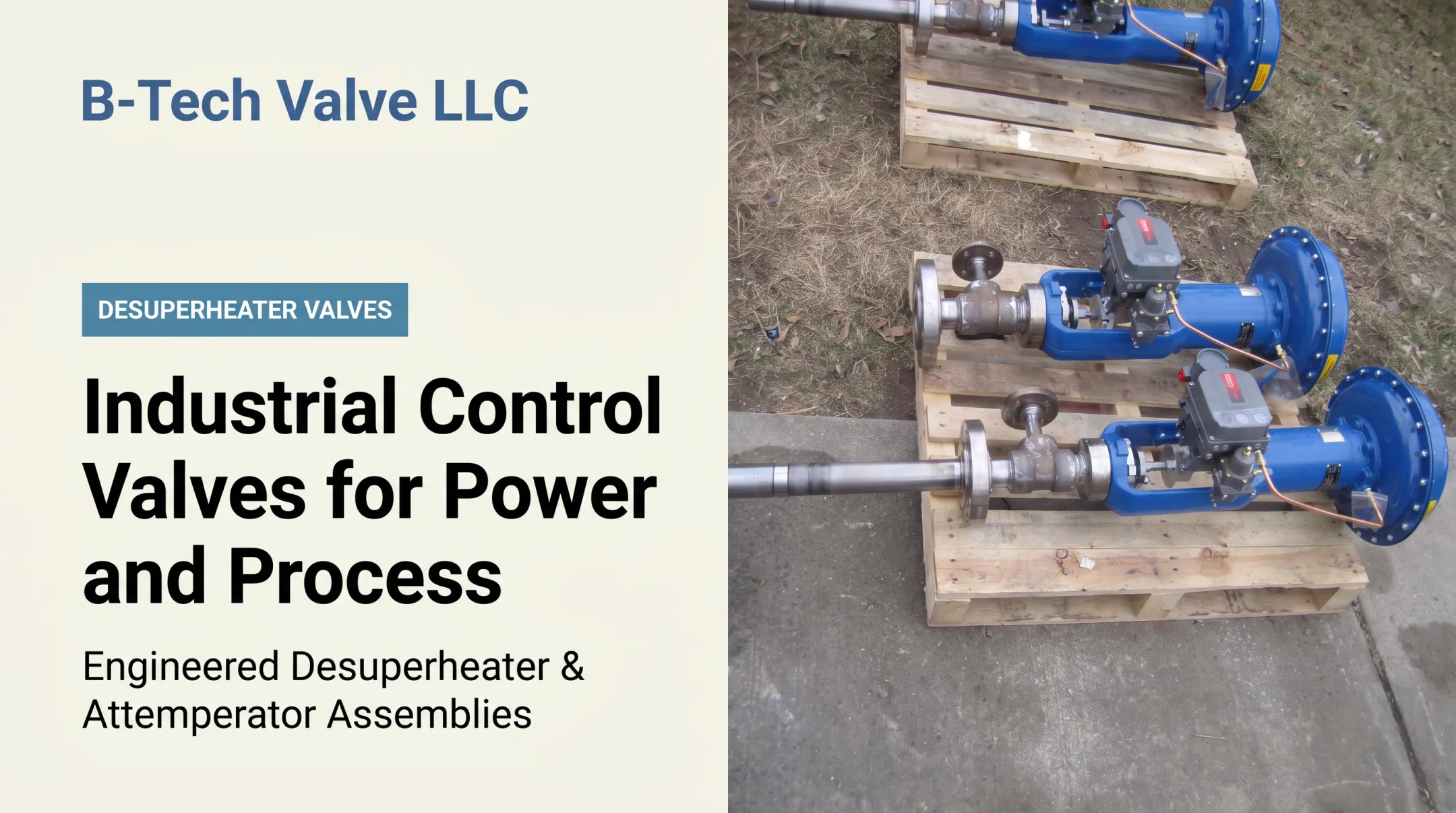
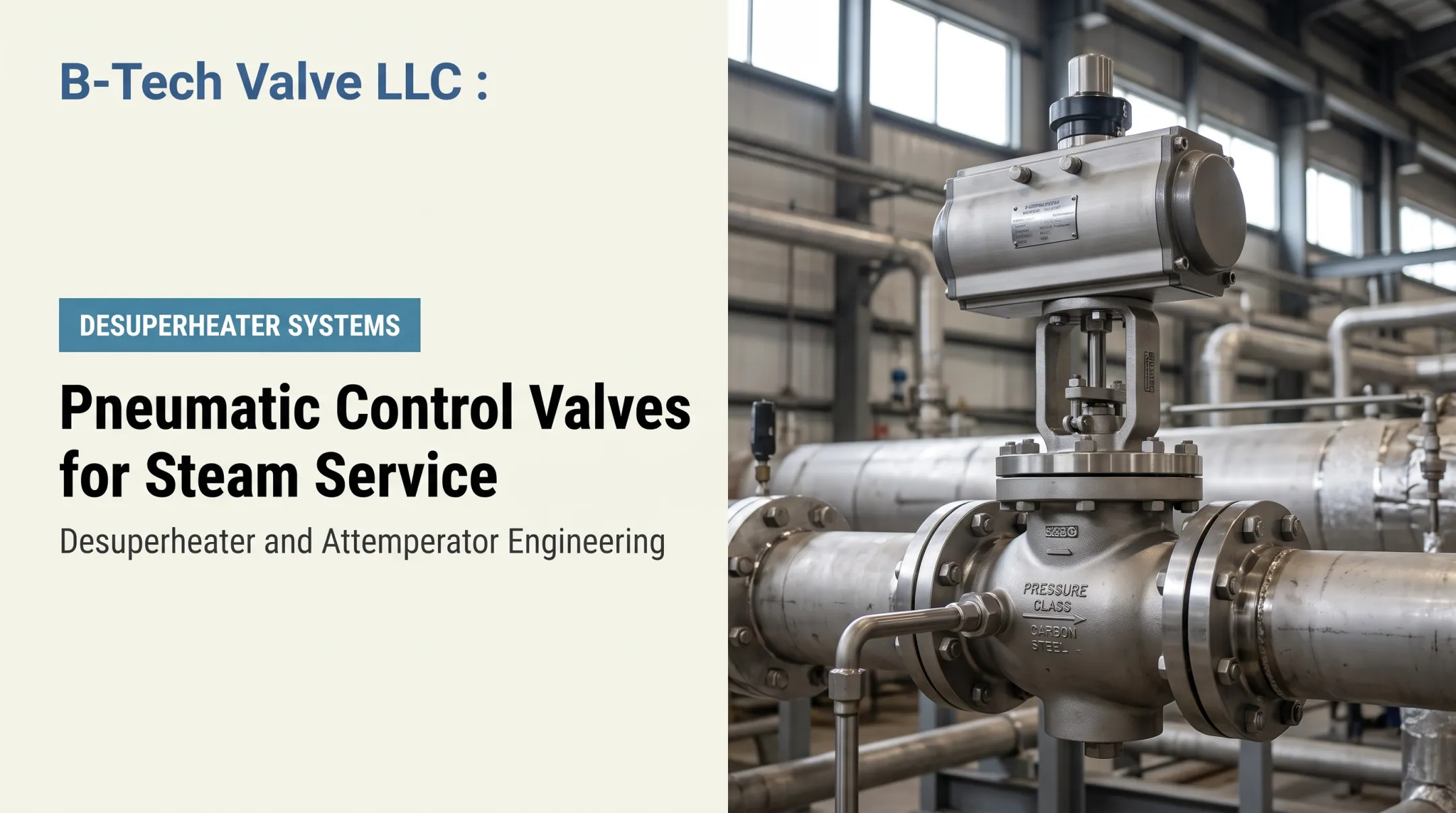
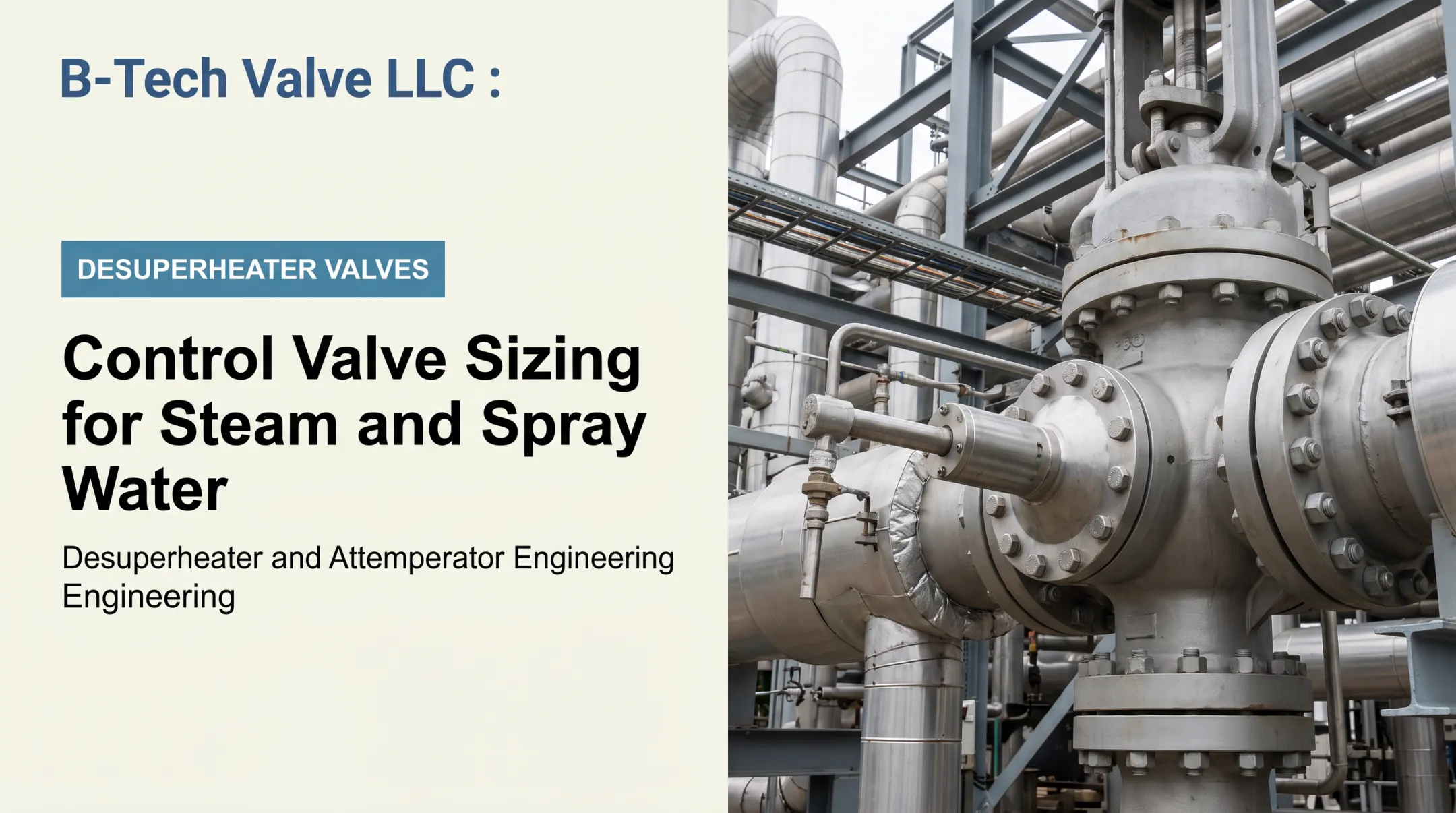
These are power-operated devices that change flow area in response to a signal, but not every "steam valve" does the same job. A conventional throttling control valve manages flow or pressure by opening and closing. A desuperheater (also called an attemperator) injects cooling water into superheated steam to pull the temperature down before that steam reaches sensitive equipment. Confusing the two during specification is a common and expensive mistake.
This guide covers how steam control valves work, the major valve types, how to size and select the right one, installation risks that trip up even experienced engineers, and what data you need before requesting a quote or replacement.
Key Takeaways
- Match the valve to the controlled variable, steam conditions, flow range, pressure drop, materials, and fail-safe needs
- Globe, rotary, spray-ring, probe-type, and combined designs serve different duties and are not interchangeable
- Desuperheater results hinge on atomization, evaporation distance, and accurate temperature feedback
- Full operating data upfront prevents oversized, undersized, or mismatched replacements
What Is a Steam Control Valve and How Does It Work?
What a steam control valve does
A steam control valve changes its effective flow area to regulate steam flow, pressure, or downstream temperature based on a controller signal. The valve body houses the trim, meaning the plug, seat, and cage that actually throttle the flow.
A stem or shaft connects that trim to an actuator, which supplies the force to move it. A positioner translates the controller's signal into precise valve position, while sensors feed real process data back into the loop. Each piece has a distinct job:
- Body and trim — contain and shape the flow path
- Stem or shaft — transmits actuator motion to the trim
- Actuator — supplies the force or torque to reposition the trim
- Positioner — ensures actual valve position matches the commanded signal
- Sensors — measure the process variable being controlled
How the control loop operates
The sequence is straightforward in concept, harder in execution. A sensor measures a process variable—pressure, flow, or temperature—and compares it to a setpoint. A PLC or DCS calculates the error and sends a correction signal to the actuator, which repositions the valve.
Say a header needs 150 psig and demand drops suddenly. The valve closes slightly, reducing flow area and pressure drop until the measured pressure returns to setpoint. Valve position, available pressure drop, and downstream conditions are all interacting at once, which is why sizing for a single operating point rarely works.

Pneumatic actuation dominates industrial plants because compressed air is already available at most sites and spring-and-diaphragm designs are simple and reliable. Electric and hydraulic actuation exist too, but confirm instrument air quality, electrical classification, and hydraulic power availability before committing to any option.
Fail-safe and control behavior
Fail-open, fail-closed, and fail-in-place are not interchangeable defaults. Fail position depends on what happens downstream if the valve loses signal or power:
- Fail-closed — appropriate when uncontrolled flow creates an overpressure or overheating hazard
- Fail-open — used when stopping flow would damage equipment or create a different hazard
- Fail-in-place — traps actuator pressure to hold position, used when neither extreme is safe
The right choice is application-specific. It should come from the plant's control narrative and safety review, not a catalog default.
Types of Steam Control Valves
Linear-motion control valves
Globe valves remain the workhorse for steam throttling because they offer precise controllability, a range of flow characteristics, and trim options suited to high pressure drops.
- Single-seat globe valves offer tight shutoff but require more actuator force to overcome unbalanced pressure
- Double-seat globe valves balance forces across two ports, reducing actuator sizing, though industry has moved away from them due to leakage limitations
- Balanced-trim designs cancel most static plug force, cutting actuator force requirements while maintaining capacity
Leakage class matters here. Metal-to-metal seating typically achieves Class II, with Class III possible on specific designs, so verify the rating against your shutoff requirement rather than assuming.
Rotary-motion control valves
Ball, butterfly, and eccentric plug valves offer compactness and high capacity in large line sizes where a globe valve would be bulky and expensive.
- V-notch ball valves give equal-percentage characteristics and wide rangeability
- High-performance butterfly valves can achieve linear behavior over travel, with offset geometry reducing disk-seat wear
- Eccentric plug valves suit throttling where space is limited, but verify steam-specific pressure-drop and shutoff data from the manufacturer directly
A rotary valve built for isolation is not automatically suited to modulating steam service. Isolation valves typically lack the characterized trim or control-specific geometry needed for stable throttling, so confirm the trim is rated for continuous modulation, not just open-closed duty.

Steam temperature control and desuperheating valves
Desuperheaters inject water into superheated steam so it evaporates and pulls heat out of the steam, lowering its temperature to a controlled setpoint. Two designs dominate:
- Probe-type desuperheaters insert into the pipe with a variable-nozzle mechanism, often combined with the control valve itself in one assembly
- Spray-ring desuperheaters distribute water around the pipe circumference through fixed nozzles, fed by a separate temperature-control valve
Pipe size, available installation length, steam velocity, and required turndown drive the choice between them.
B-Tech Valve's LPD is a probe-type, variable-nozzle design that combines the control valve and desuperheater in one assembly for pipes 6 inches and larger. It inserts through a 3-inch flanged connection at 90 degrees to the pipe.
The SPAD is a fixed-nozzle, spray-ring unit for pipes 4 inches and smaller. It clamps between two pipe flanges and receives water from a separate control valve.
Two-port versus three-port arrangements
Two-port valves throttle flow in a single path, which is how most steam control and desuperheating applications work. Three-port valves mix or divert flow between two paths and show up far more often in liquid or heat-transfer circuits than in direct steam desuperheating duty.
| Valve Category | Primary Duty | Key Advantage | Key Limitation |
|---|---|---|---|
| Globe (single/balanced) | Throttling, tight shutoff | High controllability | Limited to smaller line sizes |
| Ball/butterfly (rotary) | Large-line throttling | Compact, high capacity | Needs control-specific trim |
| Probe-type desuperheater | Combined valve + temperature control | One assembly, fewer failure points | Requires adequate pipe size |
| Spray-ring desuperheater | Temperature control, small pipe | Simple, low-profile | Needs separate control valve |
How to Select the Right Steam Control Valve
Define the process duty first
Start by naming the controlled variable: steam flow, downstream pressure, outlet temperature, or heat input. That single decision determines whether you need a throttling control valve, a desuperheater, a combined pressure-reducing and desuperheating station, or multiple coordinated valves.
Next, identify what poor control actually costs you. Equipment overheating, insufficient heat transfer, wet steam carryover, unstable downstream pressure, and seal or piping damage are all real consequences tied to specific valve failures, not generic risks.
Gather complete operating conditions
Sizing against one "normal" flow point is the single most common selection mistake. You need minimum, normal, and maximum cases for:
- Upstream and downstream pressure
- Steam temperature, quality, and mass flow range
- Pipe size and available pressure drop
- Operating hours and startup conditions
- Required outlet temperature (for temperature control)
For desuperheater applications, add cooling-water pressure, temperature, quality, flow range, injection location, and evaporation distance. Minimum and maximum cases matter because they drive rangeability, valve authority, and turndown.
A valve sized only for the maximum case often performs poorly, or not at all, at low loads. The ISA's sizing standard provides the accepted equations for flow capacity under installed conditions. Have your sizing calculation checked against it.

Select body, trim, and materials
Material and trim choices come down to pressure class, temperature, velocity, and the chemistry of both the steam and the cooling water:
- Balanced trim reduces actuator force on high-pressure-drop applications
- Hardened trim resists erosion in high-velocity or wet-steam service
- Bellows sealing addresses fugitive emission concerns on the stem
- Noise attenuation trim manages aerodynamic noise on high pressure-drop letdown
Verify pressure-temperature ratings, end connections, and face-to-face dimensions against current manufacturer documentation and ASME B16.34, which governs ratings, dimensions, materials, and testing for this class of valve.
Choose the actuator and control accessories
Actuator sizing has to account for differential pressure, shutoff force, packing friction, spring range, and required stroke speed, not just the valve's nominal size. Positioners, I/P converters, solenoids, and limit switches all need to match the plant's PLC or DCS protocol.
Treat actuator action and fail position as a safety decision, not a catalog preference. The correct spring range and fail direction come out of the process hazard review, not the vendor's standard offering.
Evaluate the B-Tech Valve product fit
For desuperheater-specific applications, B-Tech Valve offers two application-sized assemblies:
- LPD: a combined variable-nozzle actuated control valve and desuperheater for steam pipes 6 inches and larger
- SPAD: a spray-ring desuperheater for steam pipes 4 inches and smaller, used with a separate temperature control valve
Both are built from U.S.-sourced components with final assembly and testing done in-house, and they're offered across ASME B16.34 pressure classes. Neither is a drop-in fit without a completed sizing review against your actual operating data.
If you're a power plant, HRSG facility, refinery, or process plant evaluating a replacement, especially during an outage when domestic availability matters, send your operating data for a review. That is the fastest way to confirm fit.
Installation and Operating Considerations
Installation location and downstream evaporation
A desuperheater needs enough straight pipe downstream for injected water to atomize and fully evaporate before it reaches the temperature sensor or any sensitive downstream equipment. Skip this, and you get liquid water carryover instead of controlled, dry steam.
- Confirm straight-run requirements against the manufacturer's certified installation drawing, not a generic rule of thumb
- Account for nearby elbows, reducers, and pipe orientation, which all affect spray distribution
- Place the thermowell per manufacturer guidance, typically with the tip reaching toward pipe center for accurate measurement
- Provide drainage and access for inspection
Water quality and injection control
Cooling-water cleanliness and pressure stability directly affect spray pattern and nozzle condition. Dirty water clogs nozzles; unstable pressure disrupts atomization. Both wreck outlet-temperature control.
Excessive water injection carries real risk. The POWER magazine report on attemperation points to thermal shock as a documented failure mode when injection into interstage lines isn't properly controlled.
Overinjection can also produce wet steam, erosion, and carryover damage to downstream equipment. Turbine water induction specifically can generate component thrust loads far beyond normal operating levels, according to EPRI's turbine report on water induction in steam turbines.

Commissioning and maintenance
Before putting a new or replacement valve into service:
- Calibrate the actuator and verify travel limits through an automatic stroke check
- Confirm sensor accuracy against a known reference
- Tune the control loop across the expected load range, not just at normal flow
- Check for leaks at all connections and packing
- Stroke-test across the full operating range before handoff
During planned outages, inspect trim, nozzles, spray rings, seals, packing, strainers, and drains. Inspection intervals should reflect service severity and your plant's own history with the equipment, not a fixed calendar date.
Steam Control Valve Specification Checklist
Before requesting a sizing recommendation or quote, gather:
- Controlled variable (flow, pressure, temperature, or combination)
- Steam composition, pressure, temperature, and quality
- Minimum, normal, and maximum mass flow
- Line size, pressure class, and required pressure drop
- Materials of construction and trim requirements
- Required rangeability, noise limits, and leakage class
- Actuator utility (air, electric, hydraulic) and fail position
- Cooling-water pressure, temperature, and flow range (desuperheaters)
- Installation constraints, including available straight run
Request a sizing calculation, outline drawing, control-valve characteristic curve, and actuator sizing calculation from any vendor before finalizing a purchase.
A word of caution: a "nominally matching" replacement can still fail if trim geometry, actuator force, water pressure, downstream distance, or connection dimensions differ even slightly from the original design. Matching nominal pipe size and pressure class is necessary but not sufficient.
Frequently Asked Questions
What is a steam control valve?
A steam control valve is a power-operated device that regulates steam flow or pressure by changing its flow area. It's distinct from a desuperheater or attemperator, which injects cooling water to reduce superheated steam temperature.
How does a steam control valve work?
A sensor measures a process variable and compares it to a setpoint. The controller sends a signal to the actuator, which repositions the valve, changing flow or pressure until feedback confirms the setpoint is met.
What is the difference between a steam control valve and a desuperheater?
A control valve throttles or regulates flow and pressure. A desuperheater injects cooling water to lower steam temperature. Some assemblies, like B-Tech Valve's LPD, combine both functions in a single unit.
How do I choose the correct steam control valve size?
Use minimum, normal, and maximum flow along with upstream/downstream pressure, steam temperature, required pressure drop, and pipe size in a documented sizing calculation. Sizing on a single flow point almost always leads to poor turndown.
What information should I provide when requesting a steam valve quotation?
Provide steam conditions, flow range, line size, pressure class, outlet temperature requirements, actuator and fail-position needs, and, for desuperheaters, cooling-water pressure, temperature, and flow. Include any installation or replacement constraints too.