For US power, process, refining, chemical, and industrial boiler plants, control valve sourcing carries real operational weight. A 1994 EPRI report hosted by the Department of Energy found that control valve problems have been widespread in power plants, often because the wrong valve got specified for the actual operating conditions, with effects that reach into both plant economics and EPRI's power plant research on safety.
This guide focuses specifically on US-made control valves and separates true domestic manufacturing from companies that simply keep a US headquarters or distribute imported product. We'll walk through selection criteria, a practical shortlist, and how to verify what you're actually buying.
Key Takeaways
- The right US-made control valve manufacturer depends on your fluid, pressure, temperature, duty cycle, and documentation needs
- B-Tech Valve is a strong fit for US-made desuperheater and attemperator valves, not a full-line control valve catalog
- Full-line manufacturers suit broad plant standardization; specialists often win on application-sized steam conditioning
- Always request current country-of-origin documentation for the exact model and order, not the brand in general
- Domestic sourcing can shorten outage response and simplify spare-parts planning when properly verified
Overview of Control Valve Manufacturers in the US Market
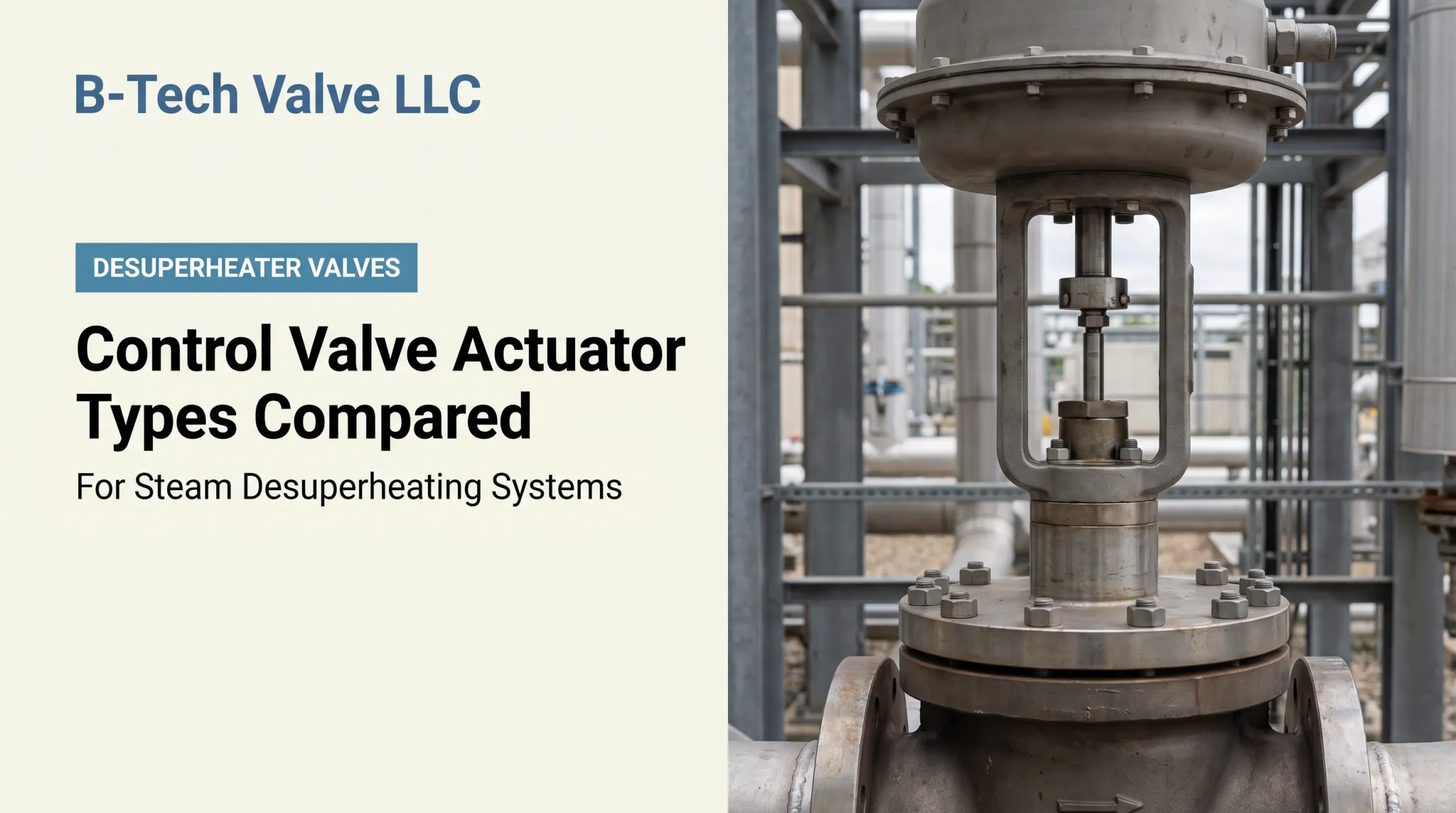
A control valve is a final control element. It modulates fluid, gas, or steam flow by changing the size of a flow passage in response to a signal from a controller.
That's different from:
- Isolation valves – fully open or fully closed, no modulation
- Check valves – prevent reverse flow, no active control
- Pressure-relief valves – open automatically to protect against overpressure, not tied to a process signal
Where control valves show up in US plants
Control valves and their close relative, the desuperheater, appear across a wide range of industrial applications:
- Steam conditioning and temperature attemperation downstream of pressure-reducing stations
- Feedwater and boiler control systems
- HRSG interstage and final-stage attemperator spray
- Refining, chemical, and petrochemical process control
- Power generation, cogeneration, and turbine bypass systems
US-made vs. US-headquartered: know the difference
This distinction matters more than most buyers realize. The FTC's Made in USA Rule requires an unqualified "Made in USA" claim to meet an "all or virtually all" domestic-content standard under the FTC's labeling rule. A US mailing address proves none of that.
Before you compare brands, separate these five categories:
- US-made – designed, sourced, and manufactured domestically
- US-assembled – final assembly happens here, but components may be imported
- US-headquartered – corporate offices are American; manufacturing could be anywhere
- US distributor – resells valves made overseas
- Global manufacturer with select domestic lines – some products are US-made, others aren't
Compare the companies below by verified production status and application fit, not brand recognition.
Top Control Valve Manufacturers: US-Made Options
This is a practical shortlist, not a market-share ranking. Check each entry against current product documentation, facility statements, and your project's country-of-origin requirements before specifying.
B-Tech Valve LLC
B-Tech Valve is a New Jersey company founded in 2007 that designs and sells American-made desuperheater and attemperator valves for power and process plants. The company specializes in steam conditioning rather than general-purpose control valves.
Founder Charles Bauer built the company around a specific gap: after a former employer closed its Blue Bell, Pennsylvania plant and moved manufacturing offshore, he started designing desuperheaters around parts made by local US machine and fabrication shops. He brought over two decades of experience applying valves and desuperheaters in power-plant and refinery settings to the new venture.
What makes B-Tech different:
- Components sourced from US machine and fabrication shops
- Final assembly and testing performed in-house
- Products stocked for quick turnaround during outages
- Direct application engineering support for sizing and selection
Technical profile (verify against current product literature before specifying):
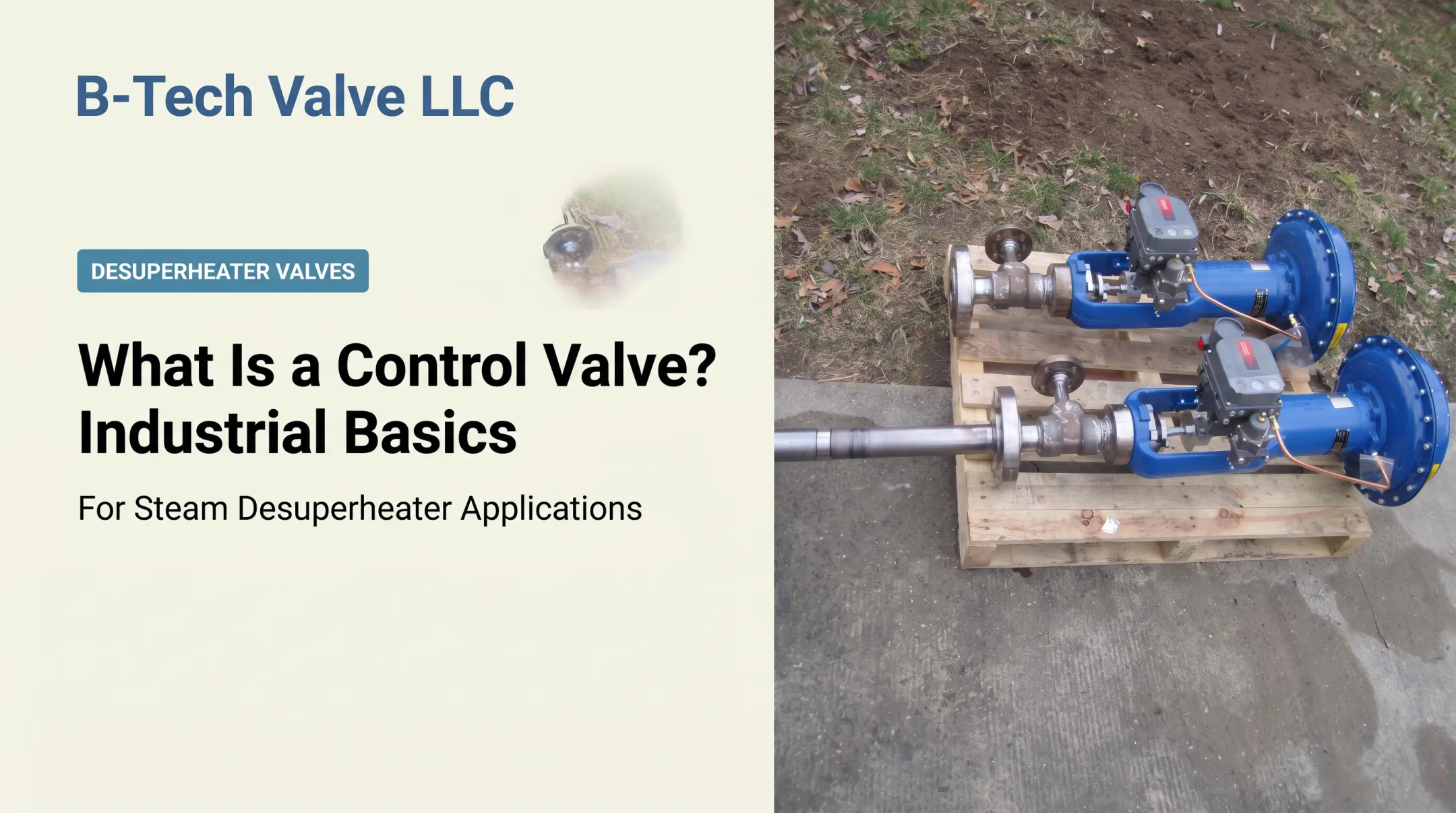
- LPD large-pipe desuperheaters for steam pipes 6 inches and larger : a probe-type, variable-nozzle, fully actuated control valve and desuperheater combined in one assembly
- SPAD spray-ring desuperheaters for steam pipes 4 inches and smaller
- ASME B16.34 pressure classes 150 through 2700
- Temperatures up to 1,200°F (650°C)
Best fit: replacing worn desuperheaters during a planned outage, conditioning superheated steam after a pressure-reducing station, or protecting downstream piping and rotating seals in power, refinery, cogeneration, waste-to-energy, and process plants.
Emerson / Fisher
Emerson's Fisher line covers throttling globe, angle, segmented-ball, three-way, ball, eccentric-plug, and high-performance butterfly control valves, plus severe-service trim and the WhisperTube noise-attenuation design.
Emerson's own brochure identifies a Marshalltown, Iowa facility exceeding 425,000 square feet, with roughly 90% of the space devoted to machining, finishing, and assembly of engineered-to-order valves. The facility lists ISO 9000, PED, and ASME certifications — though those apply to the facility, not automatically to every current SKU.
What to verify before specifying:
- Whether your exact valve model is produced at a US facility or sourced globally
- Which severe-service trims and diagnostics (such as FIELDVUE) apply to your application
- Current documentation package for steam-conditioning valves, including the Yarway desuperheater line
Best fit: plants already standardized on Fisher instrumentation that need broad product-family coverage across refining, chemical, and power applications — provided the specific model's origin is confirmed.
Flowserve
Flowserve's Valtek, Logix, Gestra, and Kämmer lines cover globe, ball, eccentric-plug, and high-performance butterfly control valves, with trim options engineered for cavitation, flashing, and high pressure-drop service.
Notable severe-service trims include CavControl, MicroCav, TigerTooth, Stealth, and the ZK Radial Stage Nozzle — all aimed at erosion, noise, and cavitation challenges common in power and process piping. ValveSight software adds diagnostic capability for condition monitoring.
Technical profile:
- Linear and rotary control valve platforms (Mark One, Mark Two series)
- Trim engineered for high differential pressure and two-phase flow
- Published US addresses in Irving, Texas and Springville, Utah ; confirm whether these are manufacturing sites or service locations for your specific order
- On-site and off-site rebuild and repair support
Best fit: facilities needing engineered control valves for severe service, with a preference for a supplier that offers repair and refurbishment alongside new product.
Baker Hughes / Masoneilan
Masoneilan's portfolio spans rotary (Camflex), cage-guided globe/angle (41005), and several severe-service families (72000, 77003, 79003, LincolnLog) built to manage pressure drop and cavitation in stages.
The Masoneilan DSH series handles steam-temperature control through atomized spraywater injection, typically paired with a separate spraywater supply valve (a different architecture than an integrated probe-type desuperheater). DSH is designed to meet ASME B31.1 and can be built to ASME BPVC Section I S-Stamp requirements.
What to verify:
- Whether your specific DSH or globe-valve model is manufactured domestically; Baker Hughes identifies Pasadena, Texas as a Valve Technology Center for support and aftermarket parts, not confirmed as a production facility for every product
- SVI/SVI3 digital positioner compatibility for diagnostics
Best fit: HRSG and boiler steam-temperature control where a separate spraywater valve architecture fits existing plant standards, and for refining or petrochemical applications needing severe-service globe or rotary trim.
Crane or CIRCOR
CIRCOR's Leslie Controls brand produces the D-Series attemperator spray valve, built to control steam temperature ahead of a turbine using superheat or reheat spray.
Leslie's published materials describe low differential-pressure, high-turndown design for superheat spray, and cavitation- and seat-leakage-resistant design for the higher differential pressures typical of reheat spray service. Listed applications include power generation, chemical, petrochemical, pulp and paper, and boiler-room feedwater controls.
What to verify:
- Leslie's Tampa, Florida address appears on installation documentation but isn't confirmed as the D-Series manufacturing site in the materials reviewed
- Current brochure revision date and specification details before quoting
Best fit: plants needing an attemperator spray valve specifically engineered for turbine-inlet steam temperature control, where CIRCOR's D-Series architecture matches existing piping and control schemes.

How We Chose the Best US-Made Control Valve Options
Picking a US-made control valve starts with one rule: verify the exact product's country of origin and manufacturing stage, not the company's headquarters address. From there, compare technical fit, quality evidence, and lifecycle support.
Matching valve design to application
Start with the fluid conditions, not the brand:
- Fluid type, flow range, and pressure drop across the valve
- Inlet and outlet temperature, including superheat or saturation conditions
- Cavitation, flashing, or noise risk at the operating point
- Actuator signal type and required fail-safe position
For example, a steam-conditioning application downstream of a pressure-reducing station typically needs a desuperheater sized for the exact steam flow and spraywater pressure available. A mismatch here can mean unvaporized water reaching downstream piping and instrumentation.
Checking manufacturing and quality evidence
Look for documentation that actually names a production facility, not just a corporate address:
- Country-of-origin statements tied to the specific model number
- Material traceability and pressure-testing records
- Compliance with ASME B16.34 for pressure-temperature ratings, dimensions, and testing on flanged, threaded, and welding-end valves
- Project-specific Buy America or Build America, Buy America requirements, if your contract calls for them
Comparing lifecycle support
Total cost of ownership isn't just the purchase price. Weigh these factors:
- Stocked configurations versus build-to-order lead times
- Outage response capability and spare-parts availability
- Repair and replacement compatibility with existing installations
- Engineering submittals and sizing support before you order
Domestic sourcing often simplifies this last category: faster communication, easier repair coordination, and shorter shipping for replacement parts. Still, confirm actual lead times for your exact configuration before you count on it.

Conclusion
A familiar logo on the nameplate is not enough. Verify the exact product's origin, confirm it matches your pressure, temperature, and fluid conditions, and check that documentation and support back it up.
Match the supplier to the job. Full-line manufacturers make sense for plants standardizing across many valve types. Specialists like B-Tech Valve make more sense when the job is an application-sized desuperheater or attemperator replacement, particularly on a tight outage schedule.
If your plant is facing a steam-conditioning replacement, contact B-Tech Valve at 609-321-2205 or Sales@B-TechValves.com to discuss line size, pressure, temperature, and turnaround needs.
Frequently Asked Questions
What does "US-made" mean when buying a control valve?
It means the valve's components and manufacturing occur domestically, not just that the company has a US office. Distributors and global manufacturers may sell imported product under a US-headquartered brand. Always request current country-of-origin documentation for the exact model you're ordering.
Which industries use control valves?
Power generation, HRSGs, refineries, chemical and process plants, industrial boilers, cogeneration, and pulp and paper facilities all use control valves to regulate fluid, gas, or steam conditions. Any process that needs precise flow modulation rather than simple on/off shutoff relies on them.
How do I choose a control valve manufacturer in the US?
Compare application engineering support, valve and trim design for your fluid conditions, pressure and temperature ratings, verified domestic manufacturing evidence, and after-sales support. Lead time and spare-parts access matter just as much as the initial spec sheet.
Are desuperheater valves considered control valves?
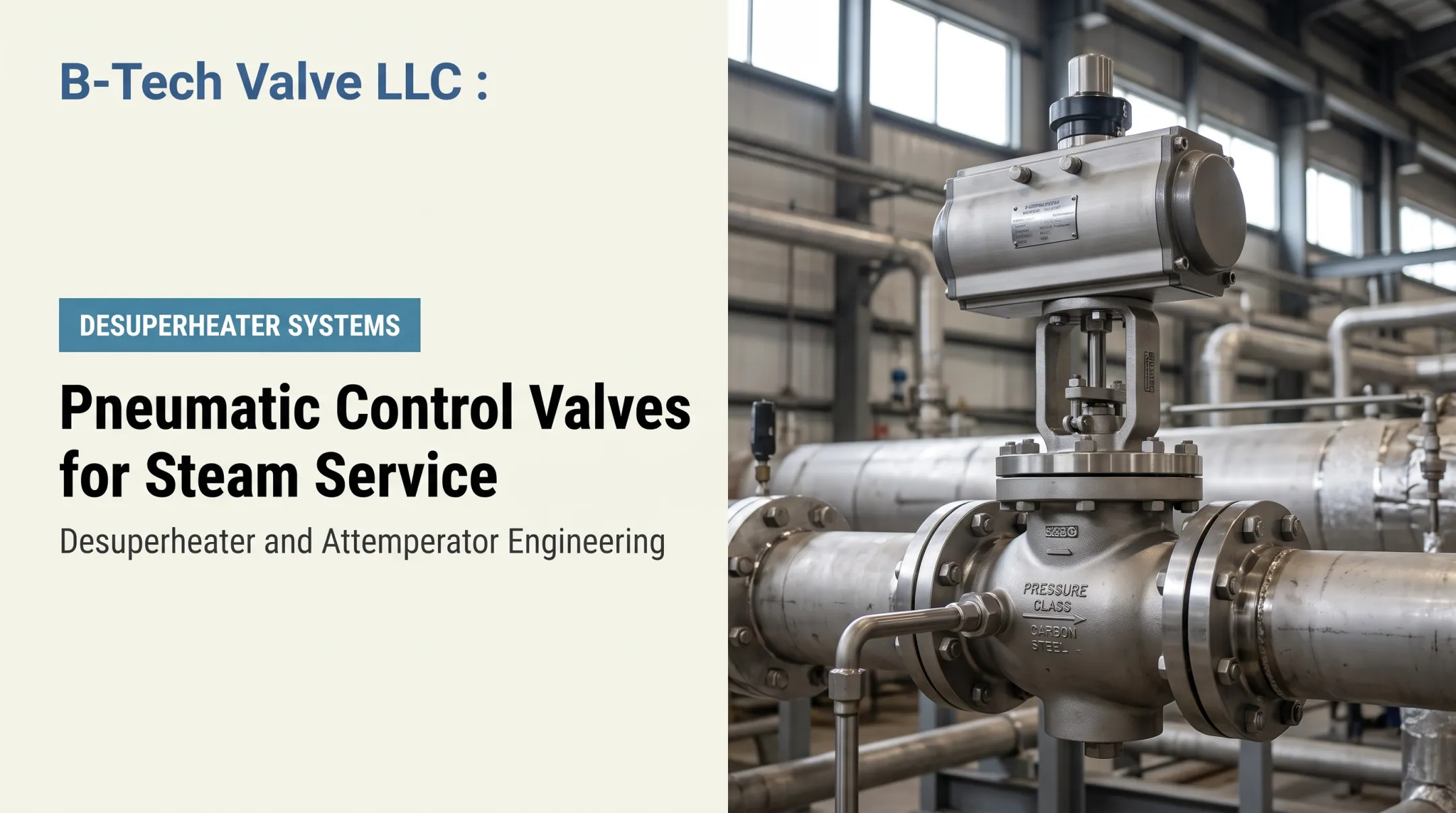
Many desuperheater and attemperator assemblies use an actuated control valve or an integrated variable-nozzle design to regulate cooling-water injection and steam temperature. The exact architecture (integrated versus a separate spraywater control valve) depends on the manufacturer and application.
What information does a manufacturer need to size a control valve?
Provide fluid or steam conditions, upstream and downstream pressure, temperature, flow range, line size, allowable pressure drop, material requirements, noise or cavitation concerns, actuator signal, and fail-safe position. The more complete the data, the more accurate the sizing.
Why does domestic manufacturing matter for replacement valves?
Verified domestic production can support faster documentation turnaround, easier communication for repair coordination, and quicker spare-parts access during an outage. Still, confirm actual availability and lead times for your specific configuration rather than assuming domestic always means faster.